ChattyCubs
£0.00 0

Basket

No products in the basket.

Using Everyday Objects to Teach Language

Using Everyday Objects to Teach Language

Everyday objects are one of the most powerful tools for early language learning. They are familiar, meaningful, and already part of your child’s world. You do not need special toys or flashcards. Real objects used in real moments help words stick.

Talking about what your child sees and touches each day builds understanding long before clear speech appears.

Why everyday objects work so well for language

Objects your child uses daily are easier for them to recognise and remember. The word connects directly to an experience, not just a picture.
  • They are seen and used repeatedly throughout the day
  • The same word comes up naturally again and again
  • Your child can touch, hold, and explore them
  • The learning happens without sitting down for “lessons”
This kind of learning feels natural and pressure-free.


Start with objects your child already loves

You do not need to name everything at once. Pick a few objects your child is already interested in and repeat those words often.
  • Cup, spoon, plate
  • Shoe, sock, coat
  • Ball, car, teddy
  • Book, light, door
Say the word clearly and simply. One or two words is enough.

Talk during everyday routines

Daily routines are full of easy language opportunities.
You are already there, the object is already in front of you, and your child is paying attention.

Mealtimes

Parent naming a cup and spoon during a toddler’s mealtime.
  • “Cup”
  • “Spoon”
  • “More”
  • “All done”
Repeat the same words each day so your child hears them often.

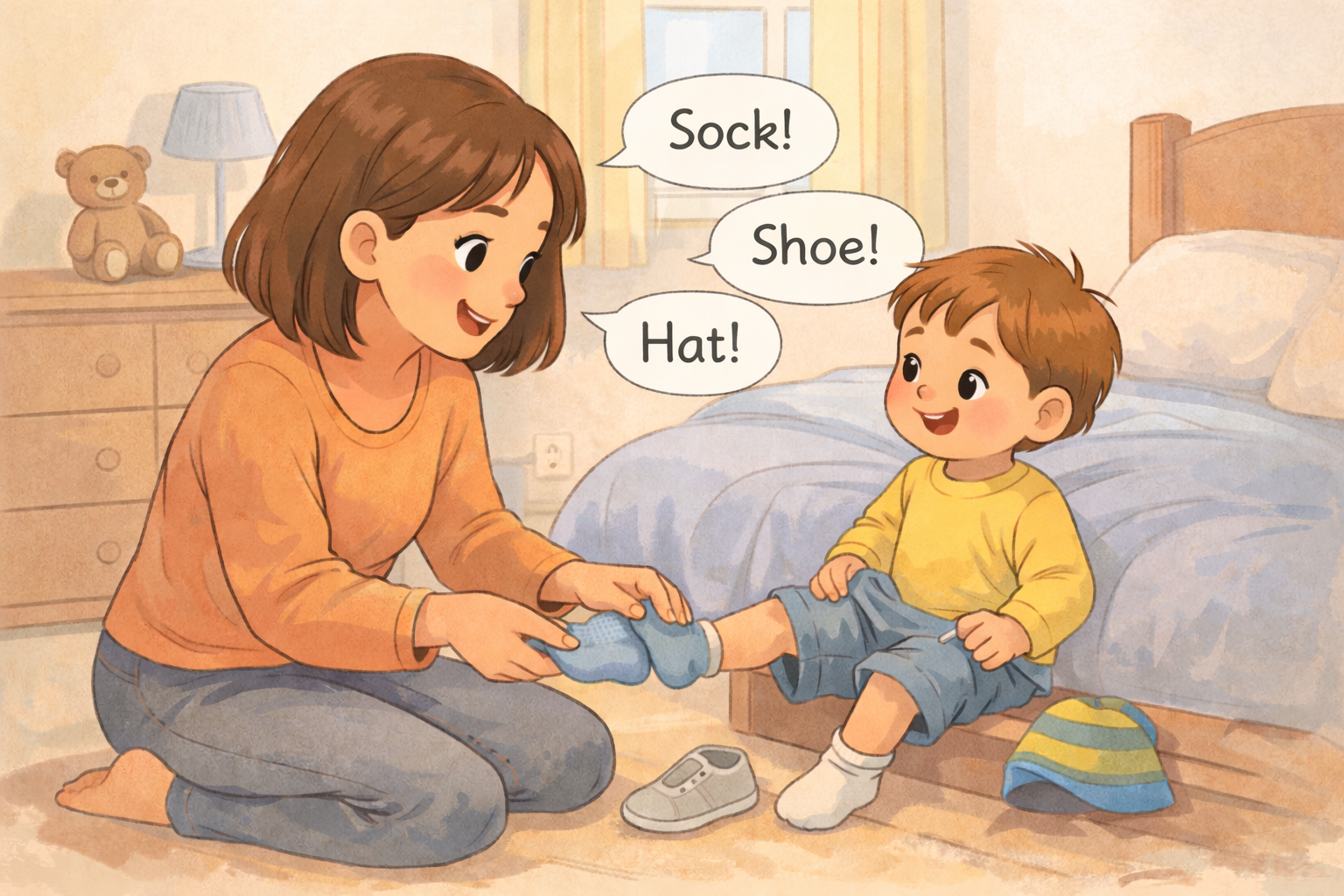
Getting dressed

Parent naming clothes while helping a toddler get dressed.
  • “Sock on”
  • “Shoe”
  • “Hat”
  • “Off”
Pause after saying the word. Your child may look, smile, or try a sound back.

Follow your child’s focus

Language grows best when you talk about what your child is already looking at or holding.

If they pick up a car, say “car”.
If they bang a spoon, say “spoon” or “bang”.

There is no need to redirect them to something else. Let their interest lead.

Use repetition, not pressure

Children need to hear a word many times before they say it. This is normal.
  • Say the same word again in the same situation
  • Keep your tone calm and positive
  • Avoid asking them to repeat the word
  • Celebrate any attempt, even sounds or gestures
Understanding always comes before talking.

Linking everyday objects with books

Simple first words books help reinforce what your child sees in real life. When a book shows familiar objects, your child can make quick connections.

You can point to the picture and then point to the real object nearby.

When to expect words to appear

Some children start using words early. Others take longer but understand plenty.

Using everyday objects supports both. You are building strong foundations even if speech is slow to come.

If you want to explore this further, see:
Encouraging First Words Through Daily Routines How Play Encourages Talking Reading Routines to Boost First Words
Everyday moments matter. The more relaxed and consistent you are, the more confident your child becomes with language.

Newsletter

Join our Early Readers Club for fun learning tips, sneak peeks at new books, and free printable activities!
ChattyCubs™ 2026 All Rights Reserved.