ChattyCubs
£0.00 0

Basket

No products in the basket.

Best First Words for Babies

Best First Words for Babies

Your baby’s first words are not a test, and they are not a race. Some babies “talk” early, some take their time, and most do a bit of both, depending on the day (and how exciting the biscuit cupboard is).

This guide shares the best first words for babies (0–3), plus easy ways to encourage them at home using everyday routines. You can pick a handful to focus on this week and keep it fun.

Research highlighted by the NHS Start for Life programme shows that regularly talking, reading, and singing with your baby helps build their language and communication skills from an early age. Explore more tips on the NHS Start for Life page.
What makes a “good” first word?

The best first words are words your baby:
  • Hears often (repetition helps)
  • Can use straight away (useful words win)
  • Can say in a simple way (short, clear sounds)
  • Feels motivated to say (favourite people, food, toys)
A “first word” can also be an approximation. “Ba” for ball counts. “Nana” for banana definitely counts.
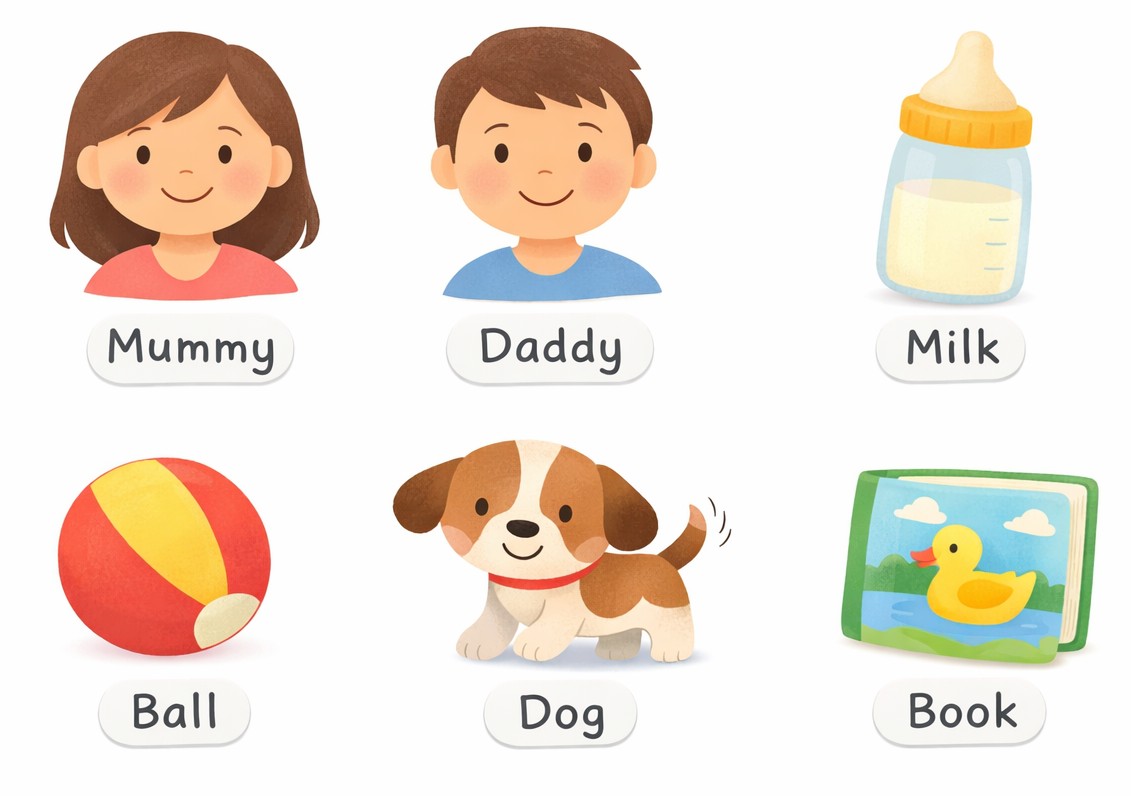
Everyday first words for babies illustrated

The best first words by category

Aim for 5–10 words at a time. Once those feel familiar, swap in a few new ones.

People words

These are often early because babies are very motivated by humans.
  • Mummy
  • Daddy
  • Nanna / Grandad
  • Baby
  • Name for a sibling (or the dog)
Everyday needs

Useful words reduce frustration for everyone.
  • Milk
  • Water
  • Snack
  • More
  • All done
  • Sleep
  • Bath
Favourite things

Motivation matters. If they love it, they will try to name it.
  • Ball
  • Teddy
  • Book
  • Car
  • Light
  • Phone
Animals

Animals are great because you can do the sound, the action, and the word.
  • Dog
  • Cat
  • Duck
  • Fish
  • Bird
Tip: animal sounds (“woof”, “quack”) often arrive before the “proper” word. That still counts as language learning.

Action words

Verbs help babies communicate what they want and what they are doing.
  • Up
  • Down
  • Go
  • Stop
  • Open
  • Help
Social words

These are powerful for connection and often show up in bursts.
  • Hi
  • Bye
  • Yes
  • No
  • Ta (thank you)
  • Please
The “starter list” of 25 best first words

If you want a simple list to start with, pick from these:
  • People: mummy, daddy, baby, nanna, pet name
  • Needs: milk, water, more, all done, snack
  • Things: ball, teddy, book, car, light
  • Animals: dog, cat, duck, fish, bird
  • Actions: up, go, open, help, stop
You don’t need all 25. Choose 10 that match your daily life.
First words starter chart for babies

Best first words by age

Every child develops differently, but these ranges can help you choose words that fit.

0–12 months: build understanding first
Focus on:
  • Names of people (“Mummy”, “Daddy”)
  • Routine words (“bath”, “bed”, “milk”)
  • Fun sounds (“woof”, “vroom”, “quack”)
Try:
  • Point, label, and pause
  • Use the same word in the same moment every time
12–18 months: first spoken words often appear
Good picks:
  • More, milk, up, go, no, hi, bye
  • Dog, cat, ball, book
Try:
  • Offer choices (“Milk or water?”)
  • Wait a beat after you label something
18–24 months: vocabulary can jump quickly
Good picks:
  • Simple phrases (“more milk”, “bye dog”)
  • More verbs (open, help, stop)
Try:
  • Expand gently on what they say
2–3 years: clearer speech and more ideas
Good picks:
  • Feelings (happy, sad, scared)
  • Describing words (big, little, hot, cold)
  • Simple questions (“what’s that?”)
Try:
  • Short chats during routines
  • Reading the same books repeatedly

How to teach first words without “teaching”

You don’t need flashcards or formal lessons. Small moments add up.

Use the “3 times then pause” trick
  • Say the word clearly up to three times
  • Pause and wait
Keep it simple and consistent
  • Use one word for one thing at first
  • Avoid switching names early on
Follow their attention
  • Name what they are already looking at
Add gesture
  • Wave for “bye”
  • Point for “that”
  • Arms up for “up”
What if my baby isn’t saying words yet?
Many babies build understanding first.

Helpful signs include:
  • Turning to their name
  • Pointing or showing objects
  • Understanding simple phrases
  • Copying actions like clapping or waving
If you are worried, speak to your health visitor or GP.

Quick activities (2 minutes each)
In the bath
  • Water
  • Splash
  • Duck
  • Wash
  • All done
At meals
  • More
  • Milk
  • Banana
  • Hot
  • Ta
With toys
  • Ball
  • Roll
  • Go
  • Stop
  • Up
Outdoors
  • Dog
  • Car
  • Bird
  • Tree
  • Bye

If you’re using ChattyCubs First Words books, you can turn page time into a simple routine:
Point to one picture and say the word slowly
Add a sound or action (“dog… woof woof”)
Pause and smile (give them space to copy)
Repeat the same page tomorrow (repetition beats variety at this age)

The best first words are simple, useful words your baby hears often and can use straight away. Good starters include: mummy, daddy, milk, more, all done, up, go, ball, book, dog, and cat.

Yes. Animal sounds like woof and quack often come before the full word, and they still show your baby is learning to connect sounds with meaning.

Start with whatever motivates your baby most. Many begin with nouns like ball or dog, then add action words like up and go. Useful words like more and all done can also be great early wins.

Aim for around 5 to 10 words at a time. Once those feel familiar in everyday routines, swap in a few new words and keep building gradually.

Use everyday routines, say the word clearly a few times, then pause to give them a chance to copy. Follow what they are looking at, keep words consistent, and add simple gestures like waving for bye.

It is common for babies to understand lots before they speak. Signs they are building language include responding to their name, pointing, copying actions, and understanding simple phrases. If you are worried, speak to your health visitor or GP.

Yes. Baby signs can reduce frustration and support communication. Spoken words still develop alongside signs, so you can use both together.

Use two-minute moments in the day. In the bath try: water, splash, duck. At meals: more, milk, banana, ta. With toys: ball, roll, go, stop. Outdoors: dog, car, bird, bye.

Newsletter

Join our Early Readers Club for fun learning tips, sneak peeks at new books, and free printable activities!
ChattyCubs™ 2026 All Rights Reserved.