ChattyCubs
£0.00 0

Basket

No products in the basket.

Tools to Track First Words

Tools to Track First Words

Keeping track of your child’s first words can feel surprisingly tricky. One day they say something new, then it disappears for weeks.

Simple tracking tools can help you notice progress, spot patterns, and feel reassured that learning is happening, even when it feels slow.

This page shares gentle, practical ways to track first words without turning it into a chore.

Why Track First Words at All?

Tracking first words is not about pressure or targets. It is about noticing and celebrating progress.

It can help you feel more confident about your child’s development and give you ideas for what to practise next.
  • It helps you notice new sounds and words you might otherwise forget
  • It shows progress over time, even when learning feels uneven
  • It helps you spot which words your child enjoys using
  • It gives you reassurance if you ever feel unsure about development

Simple Pen and Paper Tracking

You do not need an app or anything fancy. A notebook or printed sheet works perfectly well.
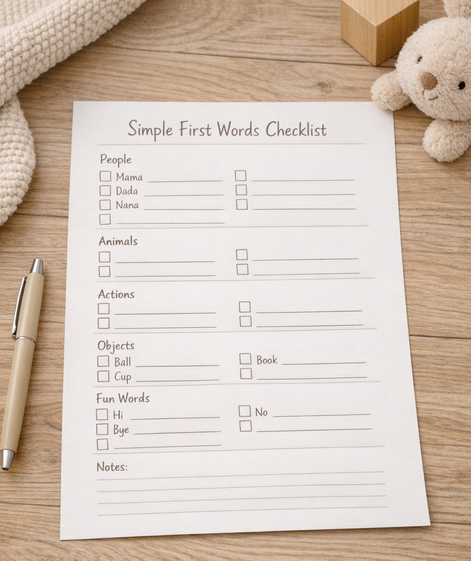
Simple paper checklist used to track a baby’s first words
You might choose to note:
  • The word your child said
  • The date you first noticed it
  • Whether they say it often or occasionally
  • The situation it came up in (playtime, mealtime, bedtime)
This can be as relaxed as jotting down a word once a week.

Using Notes on Your Phone

Most parents already have a tracking tool in their pocket.

A simple notes app lets you quickly add words as they appear, especially when life is busy.
  • Create a running list of words
  • Add a short note like “said while pointing” or “said during bath time”
  • Use dates if you find that helpful
This works well if you want something quick and flexible without extra setup.


First Words Charts and Printables

Some parents like visual tools that make progress easy to see at a glance.
First words tracking chart for toddlers
Charts often group words into categories such as:
  • People (mum, dad, nana)
  • Everyday objects (cup, ball, book)
  • Actions (go, up, eat)
  • Animals (dog, cat)
  • Social words (bye, hi, no)
These can be especially reassuring because you can see progress across different types of words.

Tracking Through Books and Reading

First words books naturally support tracking without feeling like tracking.

When you regularly read the same book, you start to notice:
  • Which pictures your child points to
  • Which words they attempt to say
  • Which sounds they repeat again and again
You can mentally note these or jot them down afterwards if you want to keep a record.

Keep It Light and Pressure-Free

The most important rule of tracking is this: it should support you, not stress you.
  • There is no need to track every word
  • Words may come and go, and that is normal
  • Understanding often comes before speaking
  • Progress is rarely neat or linear
If tracking starts to feel like homework, it is okay to pause or simplify.

When Tracking Can Be Especially Helpful

There are times when tracking feels particularly reassuring.
  • If your child is quiet compared to peers
  • If you are unsure whether new words are emerging
  • If you want to share progress with nursery or health visitors
  • If you simply enjoy seeing development over time
In these moments, even a small list can provide peace of mind.

Related learning pages

What are first words First Word Milestones by Age Practice First Words

A Gentle Reminder

Every child develops language in their own way and in their own time.

Tracking first words is a tool for noticing and celebrating progress, not a measure of success.

If you would like support choosing words to focus on, first words books can naturally guide what to introduce next through shared reading and pointing.

Newsletter

Join our Early Readers Club for fun learning tips, sneak peeks at new books, and free printable activities!
ChattyCubs™ 2026 All Rights Reserved.