ChattyCubs
£0.00 0

Basket

No products in the basket.

Practice First Words

How to Practice First Words Daily

Practising first words does not need a timetable, flashcards, or lots of prep. Little moments, repeated every day, are what help words stick.

This guide shows simple, realistic ways to practise first words daily with babies and toddlers aged 0 to 3, without turning it into a chore.

Primary keyword: practice first words daily

Why daily practice matters for first words

Toddlers learn words through repetition, not pressure. Hearing the same words again and again, in real situations, helps them understand meaning before they ever try to say the word themselves.

Daily practice works best when it:
  • Fits naturally into your normal routine
  • Uses real objects, people, and actions
  • Feels calm and playful, not like a lesson
Even a few minutes at a time adds up quickly.

Start with everyday routines

The easiest way to practise first words daily is to use things you already do.

Mealtimes

Food words are concrete and motivating.
  • Name the food before offering it (“banana”, “milk”)
  • Repeat the word as they eat
  • Pause and wait, even if they do not respond
You do not need to ask questions. Simply naming what is there is enough.

Nappy changes and dressing

These moments are repetitive, which makes them perfect for language learning.
  • Body parts (“arm”, “foot”, “tummy”)
  • Clothing (“sock”, “top”, “shoe”)
  • Simple actions (“on”, “off”, “up”)
The same words come up several times a day without any extra effort.

Use books as part of the daily rhythm

Looking at a first words book once a day is more effective than long, occasional sessions.
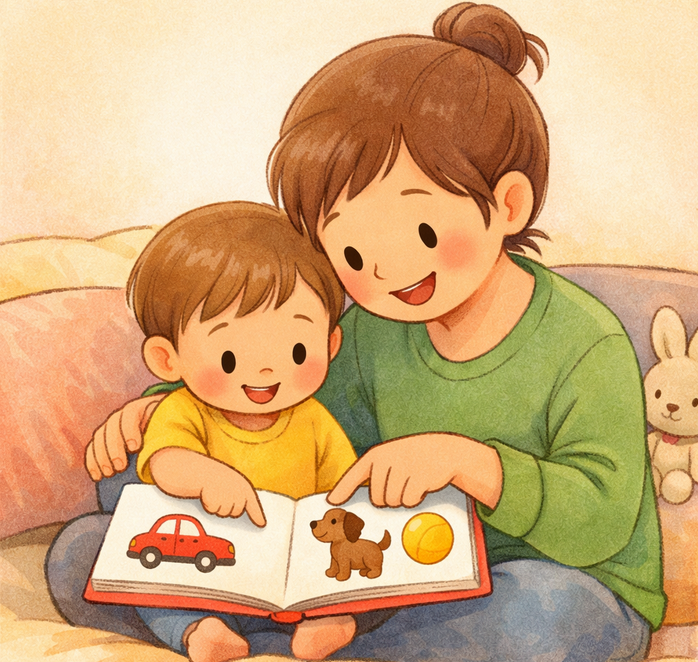
Parent reading a first words book with their toddler
Tips for daily book time:
  • Point to one picture at a time
  • Say the word clearly once or twice
  • Let your child choose what to look at
If they lose interest after two pages, that is still a success.

Repeat the same words throughout the day

Repetition does not mean drilling. It means using the same words in different moments.

For example:
  • Say “ball” during play
  • Say “ball” again when tidying up
  • Say “ball” when you see one outside
Hearing the same word in different contexts helps toddlers understand what it really means.

Follow your child’s lead

Children learn words faster when they are already interested.

If your toddler is:
  • Staring at the dog, say “dog”
  • Holding a cup, say “cup”
  • Climbing the sofa, say “up”
You do not need to introduce new words constantly. Talking about what they are focused on is enough.

Keep language simple and slow

Short phrases work better than full sentences at this stage.

Instead of:
  • “Shall we put your shoes on now?”
Try:
  • “Shoes on”
  • “On”
  • “Shoe”
Clear, slow speech makes it easier for little ears to pick out the important word.

Use songs and actions daily

Songs naturally repeat words and actions, which supports memory.
Parent and toddler practising action words through songs
Focus on:
  • Action words like “clap”, “jump”, “sleep”
  • Body parts through actions
  • Repeating the same songs each day
The familiarity is what helps the words land.

What if my child does not say the words?

Understanding comes before speaking. Many toddlers practise silently for weeks or months.

Signs daily practice is working:
  • They look at the object when you name it
  • They follow simple instructions
  • They repeat sounds or parts of words
Talking regularly still counts, even if there are no spoken words yet.

Keep expectations realistic

You do not need to:
  • Teach a new word every day
  • Correct pronunciation
  • Test your child
You are building familiarity and confidence, not performance.

How ChattyCubs books support daily practice

ChattyCubs First Words books are designed to slot easily into daily routines.

They help by:
  • Grouping words by clear categories
  • Using simple, bold illustrations
  • Encouraging pointing and repetition
One short book moment a day is often enough.

Related learning pages

What are first words When Do Babies Say Their First Word? First words by category

Newsletter

Join our Early Readers Club for fun learning tips, sneak peeks at new books, and free printable activities!
ChattyCubs™ 2026 All Rights Reserved.