ChattyCubs
£0.00 0

Basket

No products in the basket.

High-Frequency Words for Toddlers

High-Frequency Words for Toddlers

High-frequency words are the words your toddler hears and uses every day. They are simple, familiar, and incredibly powerful for early language development.

These words help toddlers understand routines, express needs, and start joining words together. You do not need flashcards or drills. Everyday moments are more than enough.

What are high-frequency words?

High-frequency words are common words that appear again and again in daily life. They are often short, easy to say, and linked to actions or people your child knows well.

For toddlers, these words usually fall into a few clear groups rather than formal reading lists.

Examples of high-frequency words for toddlers

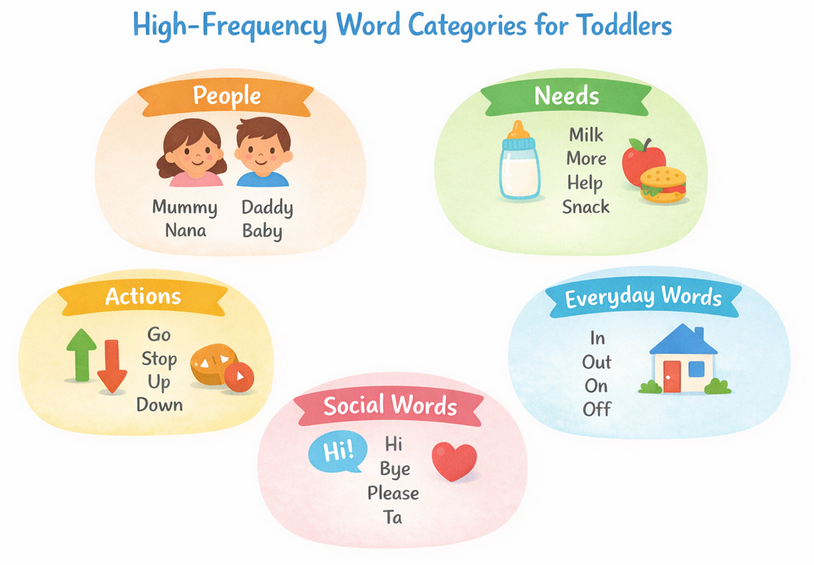
  • People: mummy, daddy, nana, baby
  • Needs: milk, more, help, snack
  • Actions: go, stop, up, down
  • Everyday words: in, out, on, off
  • Social words: hi, bye, please, ta

Why high-frequency words matter so much

These words are useful straight away. When a word helps your child get something they want, they are far more motivated to try saying it.

High-frequency words also form the building blocks for early sentences, like “more milk” or “mummy go”.

When do toddlers start using high-frequency words?

Many babies understand these words long before they can say them.
  • 9–12 months: understands familiar words like their name or “bye-bye”
  • 12–18 months: says a few useful words such as “mama”, “dada”, or “more”
  • 18–24 months: vocabulary grows quickly, with lots of everyday words
  • 2–3 years: begins combining high-frequency words into short sentences
Every child develops at their own pace. Understanding always comes before speaking.

How to teach high-frequency words naturally

The best way to teach these words is by using them often, in context, during normal routines.
High-frequency word categories for toddlers

Use repetition in real life

Say the same words during the same activities. For example, “shoes on”, “shoes off” every time you go out.

Pause and wait

After saying a word, pause for a moment. This gives your toddler time to process and attempt a sound or word.

Model, do not quiz

Avoid asking “what’s this?” repeatedly. Instead, name the object or action clearly and calmly.

Follow your child’s lead

If your toddler is focused on something, talk about that. Interest drives learning.

High-frequency words and first words books

Well-designed first words books focus heavily on high-frequency vocabulary. They show clear images with simple, familiar words that link directly to a child’s world.

This is exactly why books like ChattyCubs First Words focus on everyday language rather than rare or abstract words.

Reading little and often, even just a few pages at a time, makes a real difference.

How many words should I focus on?

You do not need long lists. A small number of well-used words is far more effective.
  • Start with 5–10 useful words
  • Use them many times a day
  • Add new words slowly as confidence grows
If a word is helping your child communicate, it is doing its job.


Related learning pages

Best First Words for Babies When Do Babies Say Their First Word? What Are First Words

Newsletter

Join our Early Readers Club for fun learning tips, sneak peeks at new books, and free printable activities!
ChattyCubs™ 2026 All Rights Reserved.